
Keeping a commercial freezer cold is very different from keeping an office or retail space comfortable. Comfort cooling systems are designed around maintaining an acceptable indoor environment for people. Freezer and low temperature systems, on the other hand, must hold products within much narrower operating conditions while dealing with moisture, frost, door openings, changing loads, and long operating hours.
That difference makes temperature stability a critical part of low temp refrigeration. A small change that might barely be noticed in an air-conditioned room can signal a developing refrigeration problem. If the system cannot recover properly, the result may be product damage, longer compressor run times, excess frost, increased energy use, or an unexpected shutdown.
Low Temperature Refrigeration Has a Much Smaller Margin for Error
A standard air-conditioning system can cycle as indoor conditions change. A slight variation in room temperature may affect comfort, but it does not necessarily create an immediate business risk. Commercial freezers operate under a different set of expectations.
Facilities relying on low temp refrigeration need equipment capable of maintaining stable conditions even as operating loads change. This includes restaurants, food processing facilities, grocery operations, warehouses, and other businesses storing products at freezing or below-freezing temperatures.
The U.S. Food and Drug Administration recommends keeping freezers at 0°F (-18°C), illustrating how important reliable temperature control is for frozen food storage.
The challenge is not simply reaching a low temperature. The refrigeration system has to maintain that condition consistently.
Small Deviations Can Point to Larger Problems
A brief temperature change is not automatically evidence of equipment failure. Door openings, product loading, and scheduled defrost cycles can all affect readings temporarily.
What matters is how the system responds.
If temperatures climb and remain elevated, fluctuate repeatedly, or take increasingly long to return to the normal range, the system may be losing capacity. Controls, refrigerant conditions, airflow, compressors, evaporators, or other components may need to be evaluated.
That is why temperature trends often provide more useful information than a single reading.
Defrost Is Part of Temperature Control
Moisture creates a major challenge in freezer environments. When humid air enters a low temperature space, moisture can collect and freeze on the evaporator coil. Frost accumulation restricts airflow and reduces the coil’s ability to absorb heat.
Low temperature refrigeration systems therefore require a defrost strategy that periodically removes this buildup.
The difficulty is that defrost temporarily introduces heat into an environment designed to stay frozen. The controls have to manage that process without allowing unnecessary temperature swings.
Defrost Timing Has to Match the Application
Too little defrost can allow ice to accumulate until airflow and system performance suffer. Too much defrost can introduce unnecessary heat, increase energy consumption, and make the refrigeration equipment work harder to restore the required temperature.
Defrost performance can also be affected by operating conditions such as:
- Frequent door openings
- High humidity
- Heavy product loading
- Damaged door gaskets
- Changing facility activity
- Evaporator airflow conditions
The right schedule depends on the equipment and how the space is actually used.
Problems with heaters, sensors, termination controls, timers, or related components can further disrupt the process. A technician servicing a low temperature system therefore needs to consider both cooling performance and the defrost sequence.
Controls and Alarms Help Protect More Than Equipment
Temperature controls in a commercial freezer are directly connected to product protection and business continuity. Their job is not simply to tell the compressor when to operate. Depending on the system, controls may coordinate refrigeration demand, defrost, fans, alarms, and other operating functions.
Temperature monitoring provides another layer of protection.
The FDA recommends periodically checking freezer temperatures rather than assuming the equipment is maintaining its intended condition. In commercial applications, monitoring may be considerably more sophisticated, especially where large quantities of temperature-sensitive inventory are involved.
Alarm Conditions Need Context
An alarm is valuable because it provides an opportunity to respond before a temperature issue becomes a larger loss. However, alarm settings also need to account for normal operation.
A short temperature increase associated with a scheduled defrost cycle, for example, is different from a sustained rise caused by a failed compressor or refrigeration issue.
Controls should help operators distinguish temporary operating events from conditions requiring attention. Poorly configured alarms can generate repeated nuisance notifications, while alarm thresholds that are too permissive may delay the response to an actual problem.

Refrigerant Problems Can Affect System Stability
Low temperature refrigeration places significant demands on the refrigeration circuit. The equipment must continuously move heat from an already cold environment to a warmer surrounding environment.
Proper refrigerant conditions are essential to maintaining the system’s designed capacity.
A refrigerant leak, improper charge, restriction, or another circuit problem can reduce cooling performance. The first noticeable symptom may not always be complete equipment failure. Instead, operators may notice longer run times, slow temperature recovery, inconsistent temperatures, or difficulty maintaining the normal setpoint during periods of heavier demand.
These symptoms warrant professional evaluation because several different system conditions can produce similar behavior.
For businesses experiencing unreliable performance, commercial refrigeration repair should focus on identifying the underlying cause rather than simply reacting to the temperature reading itself.
Compressor Performance Matters More as Loads Increase
The compressor is central to the refrigeration cycle, and low temperature applications can place substantial operating demands on it.
A freezer may need to run for extended periods to maintain its setpoint, especially during heavy use. Product loading, frequent door openings, high ambient temperatures, and frost accumulation can all increase the cooling load.
When a compressor begins losing capacity or another part of the system forces it to operate outside normal conditions, temperature recovery may become slower.
Longer Run Time Is Not Always More Cooling
It is easy to assume that a compressor running continuously means the freezer is simply working harder. In reality, extended operation without satisfactory temperature recovery may indicate that the system is struggling.
The problem could involve the compressor, but it could also involve refrigerant conditions, evaporator performance, condenser conditions, airflow, controls, or another component.
This is why low temperature service should consider the entire refrigeration system instead of treating compressor operation as an isolated issue.
Temperature Monitoring Protects Inventory and Operations
For many businesses, the value stored inside a freezer can exceed the cost of individual refrigeration components. A temperature problem can put large quantities of food, ingredients, pharmaceuticals, or other temperature-sensitive products at risk.
Consistent temperature monitoring gives facility teams visibility into system performance before a problem becomes obvious through product condition.
Monitoring can reveal patterns such as:
- Increasing temperature during busy periods
- Slow recovery after defrost
- Overnight temperature drift
- Repeated alarm events
- Unusually long compressor cycles
- Differences between expected and actual temperatures
Those patterns can help identify a developing performance issue before the equipment stops cooling altogether.
For frozen food specifically, the FDA notes that maintaining food at 0°F helps preserve frozen storage conditions, although product quality can still decline over time.
Equipment Selection Affects Long-Term Temperature Stability
Reliable operation starts before the equipment is turned on for the first time. System design, equipment sizing, controls, evaporator selection, condenser conditions, and the intended application all influence future performance.
Professional refrigeration installation should account for the actual temperature requirements and expected operating load of the facility.
A system intended for ordinary refrigerated storage should not automatically be treated as interchangeable with equipment designed for true low temperature operation.
Load Conditions Need to Be Considered
Refrigeration equipment has to manage more than the temperature of the room itself. Designers may need to account for heat entering through walls and doors, lighting, people, product loads, infiltration, equipment operation, and other sources.
Low temperature environments can be especially sensitive to these factors because the system is maintaining a substantial temperature difference between the refrigerated space and its surroundings.
Proper equipment selection helps the system recover from normal disturbances without excessive run times or unstable temperatures.
Preventive Service Is About Maintaining Stability
Waiting for a freezer to stop cooling completely can turn a manageable service issue into an operational emergency.
Low temperature systems often provide earlier indications that performance is changing. Temperature recovery may become slower. Frost patterns may change. Defrost cycles may become less effective. Compressors may run longer. Alarms may occur more frequently.
Regular professional service gives technicians an opportunity to evaluate these changes while the system is still operating.
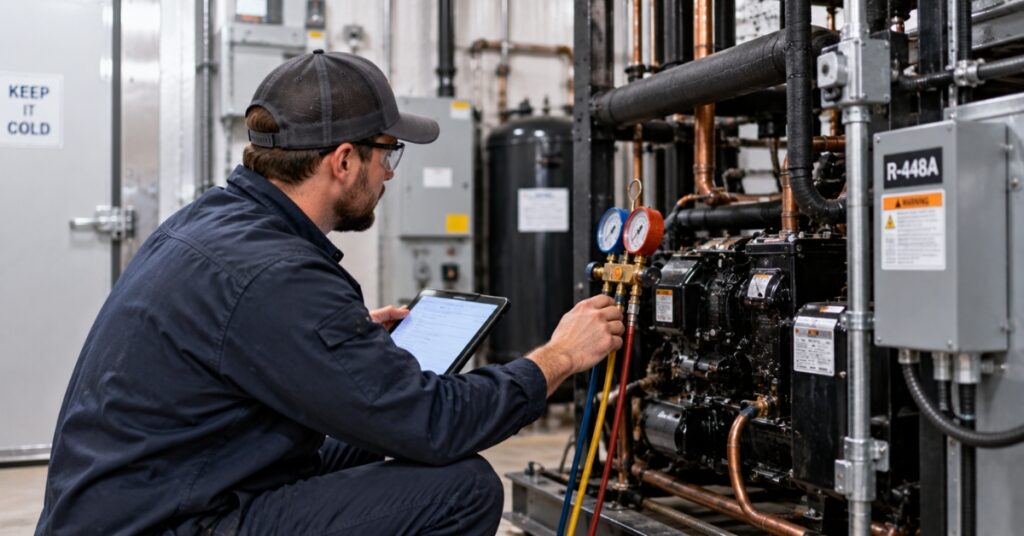
This can include reviewing operating temperatures, controls, defrost performance, refrigerant circuit conditions, electrical components, compressor operation, airflow, and other factors relevant to the specific equipment.
Facilities can also benefit from reviewing refrigeration maintenance practices alongside temperature records. Looking at system condition and operating trends together can provide a clearer picture than waiting for an obvious failure.
Low Temperature Service Requires a Refrigeration-Specific Approach
Commercial air conditioning and low temperature refrigeration both move heat, but their operating requirements are not the same.
True low temperature systems have to maintain freezing conditions while managing frost, defrost cycles, changing product loads, refrigerant conditions, and extended equipment operation. Their controls and service requirements reflect those demands.
For a commercial facility, stable refrigeration supports much more than comfort. It protects inventory, reduces the likelihood of disruptive failures, and helps operations continue without unexpected temperature-related interruptions.
Frequently Asked Questions
What is considered low temp refrigeration?
Low temp refrigeration generally refers to systems designed to maintain freezing or below-freezing environments. Commercial freezers, certain walk-in systems, frozen food storage areas, and specialized cold-storage applications can fall into this category.
Why does a freezer temperature fluctuate?
Some fluctuation can occur because of door openings, product loading, defrost cycles, and normal system operation. Repeated, prolonged, or increasingly large temperature changes may indicate that the refrigeration system is having difficulty maintaining its operating conditions.
Why do low temperature systems need defrost cycles?
Moisture can freeze on an evaporator coil and restrict airflow. Defrost cycles remove accumulated frost so the evaporator can continue transferring heat effectively.
Can a refrigerant problem cause inconsistent freezer temperatures?
Yes. Refrigerant leaks, improper charge, restrictions, and other refrigeration circuit issues can reduce system capacity and contribute to longer run times or poor temperature recovery. A qualified refrigeration technician should diagnose the specific cause.
Why is continuous temperature monitoring useful?
Monitoring creates a record of how the refrigerated space performs over time. Instead of relying on one temperature reading, facility operators can identify trends, recurring alarms, slow recovery, or unusual temperature changes that may indicate a developing problem.
Is low temperature refrigeration serviced differently from standard air conditioning?
Yes. Although both systems use refrigeration principles, low temperature equipment has different operating conditions and may involve specialized defrost controls, evaporator configurations, refrigerants, compressors, and temperature requirements. Service should account for the complete low temperature application.